Mostrando entradas con la etiqueta South America. Mostrar todas las entradas

¿Hacia dónde va Bolivia? - Maletagate I (cont.) y Maletagate II

viernes, diciembre 21, 2007

Esta pregunta se la hace El MUNDO.es. Es necesario leer el análisis, aunque no esté enteramente de acuerdo con él. Pero sí dice algo interesante:

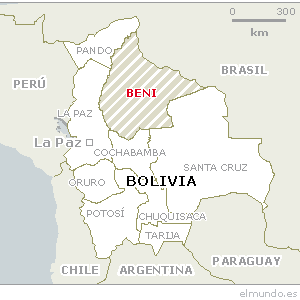
La actual polarización del país ha resucitado casi la misma línea que trazaron los colonizadores españoles, con criterios raciales, geográficos y culturales. Dibujaron, a fines del XVIII, una frontera parecida a la que ahora ha entrado en conflicto. A un lado quedó el mundo andino y altiplánico, de curtidos rostros aymaras, quechuas y los minoritarios urus, gentes de carácter introvertido y palabras parcas, encumbrado en las actuales regiones de La Paz, Oruro, Potosí, parte de Chuquisaca y parte de Cochabamba, a una altitud media de 3.500 metros sobre el nivel del mar.

Estas zonas se englobaron en el Alto Perú (o Audiencia de Charcas), por sus parecidos raciales con los incas. Al otro lado, quedó la vida cálida y abierta de las actuales Santa Cruz, Beni, Pando y parte de Tarija, como gobiernos subordinados y capitanías organizadas por los jesuitas. Hoy, sus gobernadores forman la alianza de la llamada media luna, en feroz oposición al gobierno del aimara Morales. [SUBE]

2. El reparto del tablero

Las dos diferencias sobre aquel antiguo mapa son que hoy, la capital de Chuquisaca, Sucre, y la ciudad de Cochabamba, se alían a la mitad oriental anti Morales. El derechista gobernador de Cochabamba se suma a sus pares orientales porque comparten el mismo discurso liberal, político y económico. Todos, a su vez, apoyan una histórica demanda de Sucre, para así restar poder al gobierno.

Sucre, antigua capital de Bolivia, exige que los poderes Ejecutivo y Legislativo retornen a la ciudad y no se conforma con su título de capital constitucional y sede del poder Judicial. La pelea por la capital de Bolivia, entre La paz y Sucre (que llevó al país a la guerra civil, en 1899) logró bloquear la Asamblea Constituyente más de tres meses. Morales sostuvo que fue la mejor "estrategia” de la oposición para intentar cerrar el órgano de redacción de la nueva Carta Magna que, según Evo, "la derecha nunca quiso".
Debeis leerlo entero.

Pero Morales sigue diciendo que hay un complot contra él: Me sacarán muerto, dice. Eso sí, la BBC se luce en el reportaje con una de las faltas de ortografía más bestias que he visto últimamente:

"Si quieren sacarme, me sacarán muerto del Palacio, acá vamos ha defendernos".
Si es que hace daño a la vista...

Además, insiste en que es una guerra "entre ricos y pobres", cuando lo que ha hecho ha sido saltarse el procedimiento para aprobar la Constitución nueva. Pero es mucho más fácil echar la culpa al empedrado...

La situación en Bolivia parece que se le va de las manos a Evo, lo que ha dado lugar a que Chávez amenace con intervenir. Esto ha provocado a su vez el descontento del Senado boliviano. Incluso el Movimiento Al Socialismo, el partido de Morales, ha rechazado estas declaraciones. Pero Evo está preocupado porque no se impida jugar partidos de fútbol en zonas altas.

Ya hablé aquí de la famosa maleta venezolana en la Argentina. Parece que ahora hay otra maleta venezolana, esta vez en Bolivia:
Las autoridades de Bolivia descubrieron otro maletín venezolano cargado con miles de dólares, en circunstancias similares al escándalo desatado por el empresario Guido Antonini Wilson en días pasados, publicó el diario estadounidense El Nuevo Herald.

¿Militar o ministro?

Según el matutino de Miami, se trataría del capitan de inteligencia de las Fuerzas Armadas venezolanas, Luis Michel Klein Ferrer, a quien se la encontraron unos $800 mil, en medio de contradicciones sobre la procedencia y fin del dinero.

El pasado 6 de diciembre, Klein intentaba salir apresurado del aeropuerto para evitar ser linchado " por enfurecidos pobladores de una ciudad en el norte de Bolivia", documentó el diario.

El venezolano fue entregado a las autoridades por los inconformes, quienes intentaban confiscarle el dinero, alegando que no están dispuestos a permitir que su país se ponga al servicio del presidente de Venezuela, Hugo Chávez
Aquí teneis un video relacionado con este tema:


Como podeis ver, también hay aquí una maleta venezolana llena de dinero, sin que se determine su origen y sin que pueda siquiera ser rastreado porque no hay recibo de ninguna operación de las que ha hecho Chávez (ni siquiera de su visita a Arabia Saudí...)... Magnífico, ¿eh?

____________

Morales continues blaming an international complot because of Bolivian bad situation, without even considering his (important) part of the blame. Now he has stated that he would never be removed except being if he is killed first. The situation looks so complicated for Morales that Chávez has told US "don't make us intervene in Bolivia", an statement which has provoked an angry reaction by the President of Bolivian Senate. More about this new threatening statement by Chávez here. Even the MAS (Movement to Socialism), Morales' party, has rejected it.

There is another scandal in Bolivia involving a suitcase full of money of Venezuelan origin. The facts, related in the video above can be summarised as follows: on Dec 6th a Venezuelan military plane landed on one of the northern (and one of the poorest) Bolivian districts. Military men said they were carrying "humanitarian aid" but the people, who suspected that the real cargo were weapons, threw stones at it, obliging the pilot to go back into air after very little time on land. But they left a passenger on it, Venezuelan intelligence captain, Klein Ferrer, who was nearly killed by the crowd and was saved from it by police. He could be parted from his suitcase and, when the police obliged him to open it, it was discovered that $870,000 were inside. Neither the origin or the inversion that money was going to be used to, is not known. The problem is that Chávez has given a lot of money but has never asked for a receipt (something normal if your a corrupt or the corruptor: the less proofs, the less danger you're outed).

You can also read The Devil's Excement: As Maletagate involves the Government more, the Maletagate II shows the depth of corruption in Venezuela (video in Spanish, explanation in English in The Devil's Excrement):

www.Tu.tv


Noticias relacionadas:
  1. Bolivia y China firman acuerdo de colaboración. /mode sarcasm on/ ¡Qué raro! China apoyando a Bolivia, ¿no? /mode sarcasm off/: Choquehuanca (Ministro de Exteriores Boliviano), quien acudió a la reunión acompañado de su esposa, destacó al canciller chino en el comienzo de la reunión que para Bolivia "es muy importante profundizar las relaciones de gobierno a gobierno y entre ambos pueblos", y aseguró que para el país latinoamericano los lazos con Pekín tienen gran valor estratégico.
  2. El caso de Bolivia @ El CATO Institute: Las amenazas de secesión y los reclamos de autonomías locales formulados por los habitantes de diferentes regiones se deben a esta transferencia insoportable de recursos, pero lo realmente trascendente es la salvaguarda que en todos los órdenes ayuda a implementar y, en su caso, a consolidar, el federalismo.La combinación del actual gobernante boliviano con los de Venezuela, Nicaragua y Ecuador no puede ser más explosiva. Ya había mas que suficiente con el totalitarismo cubano para que se acoplen estos personajes junto con otros que, aunque por el momento no llegan a los extremos mencionados, revelan una vocación muy poco republicana como es el caso de Argentina.
  3. Latino-Islamic terror in South America @ GP:
    Former Bolivian Congressman Jose Brechner sent the photos from a South American Hezbollah website earlier this year.
    Brechner talks about the Islamist infiltration of Bolivia HERE.
  4. The Changing Dynamic in South America @ The Counter-Terrorism blog: These leaders may see themselves as populists addressing years of historic inequities in their homelands, but their strategic alliances are ranging dangerously far afield, into sponsors of state terrorism and the growing nexus with transnational criminal syndicates. However, Iranian sphere of influence is greatly expanded if one looks at Hezbollah and its activities around the region.
  5. Los cultivos de coca han aumentado con Evo Morales, algo que no sorprende después de las múltiples llamadas al Gobierno boliviano para que deje de promover el consumo de coca mascada especialmente entre los jóvenes. (Coca's cultivation in Bolivia has increased since Evo Morales was elected Presidente, something which is not rare, considering its consumption's promotion his Government has done, specially among youths).
Posts relacionados:
  1. La crisis de Bolivia: las regiones rebeldes a Morales comenzarán el proceso de autonomía.
  2. Bolivia, en huelga de hambre contra Morales.
  3. La situación boliviana se agrava aún más (II).
  4. La situación en Bolivia se agrava aún más.
  5. Huelga en Bolivia contra la aprobación de la Constitución.
  6. Bolivia: ya van cinco muertos y la policía golpea a los periodistas.
  7. Tres muertos tras la "aprobación" de la Constitución de Evo.
  8. Bolivia hacia la guerra civil: García Linera, vicepresidente de Bolivia, reconoce el peligro de guerra civil en el país.

Venezuela: luchando por la libertad de expresión

lunes, mayo 21, 2007

[English version here].
Chávez ha retirado la concesión de una de las emisoras de TV más antiguas de Venezuela y una de las más populares: Radio Caracol TV (RCTV). Ayer decenas de miles de venezolanos salieron a la calle para protestar por el cierre, que podemos decir es la crónica de una muerte anunciada, ya que los ataques de Chavez hacia la libertad de esta cadena por no obedecerle han sido continuados y se han ido incrementando a lo largo del tiempo. Podeis ver varios vídeos (1, 2, entre otros) sobre el asunto que son más que indicativos de la saña con la que Chávez se metía con la cadena.
Los periodistas mientras eran atacados por la turba cuando iban a cubrir los acontecimientos protagoizados por Chávez, quien insistía en que estaban "envenenando las mentes del pueblo venezolano".
Para defender la cadena se ha constituido una plataforma, Free RCTV, en cuya primera página hay un vídeo que también es muy indicativo [aunque citar a Chomsky al final no me parece muy correcto, teniendo en cuenta lo que le gusta a Chávez este sujeto. ¿O sí? ;) ].
Asimismo, Chávez primero consideró que el Benedicto XVI ( ;) ) no le había criticado -cuando dijo lo de que en Sudamérica estaban creciendo mucho los totalitarismos-, pero ahora parece haber encontrado un filón de críticas. Durante su viaje, Benedicto defendió la labor evangelizadora que consideró había aportado mucho a los indígenas.
Es cierto que se cometieron errores, pero nadie duda que la civilización europea del siglo XVI era más evolucionada que la indígena americana. Además, las leyes promulgadas por la Corona de Castilla fueron las primeras que defendieron la igualdad de los indígenas de América, respecto de los ciudadanos peninsulares. Si alguien se molesta en leer el testamento de Isabel la Católica, una de las cosas en que más insiste es precisamente en que no se puede obligar a nada a los indios, incluido a la conversión. ¿Que se incumplieron las leyes? Pues como en todos los tiempos y lugares.
Pero lo que más llama la atención es que Chávez, que se ha declarado partidario del sosialihmo bolivario -que no es si no una mezcla entre el socialismo-comunismo revolucionario y el populismo sudameriano- con todo lo que ello conlleva actualmente, se escandalice de lo que pasó hace 500 años. Pero claro, si consigue que la Iglesia venezolana disminuya en influencia, lo tendrá muchísimo más fácil para conseguir el poder absoluto... del que ya está cerca.
En cuanto al genocidio indígena, sólo hay que ver a Chávez y a Evo -que ya ha dicho a la Iglesia que elija entre hacer política o ayudar a los pobres...- para darse cuenta de que no es muy cierto que digamos. En Bolivia, por ejemplo, el porcentaje de indios es del 65%. Si hubiera habido genocidio después de 500 años hubieran desaparecido.
Yo siempre que hablo con personas sudamericanas, comparo la dominación -lo pongo así porque el porcentaje de españoles en América siempre fue muy pequeño- española con la dominación romana de España. Cuando los romanos llegaron España tenía oro, plata y mercurio. De ellas, a la caída del Imperio, sólo quedaba el mercurio; de los otros nunca más se supo. España era exportadora de cereales, aceite, material de guerra, caballos, mujeres -sobre todo, bailarinas de Cádiz, aunque ahora parezca mentira, eran muy exóticas- y hombres -los íberos tenían reputación de excelentes y fieros soldados (ZP&Co. todavía no había nacido...)-, entre otras cosas.
Cuando San Isidoro de Sevilla escribe las Etimologías (siglo VI d.C.), insiste en lo que nos habían legado de bueno -el derecho, la lengua, la filosofía,etc.-. Pero no da la tabarra con la crucifixión de Indíbil y Mandonio y la violación de sus mujeres e hijas ni con el asesinato de Viriato. Porque 200 años de conquista dieron para muchas atrocidades -Sagunto en la segunda guerra púnica y Numancia frente a Escipión el Africano como más importantes, aunque seguro que si pienso un poco me acuerdo de más-.
Hecho este breve excursus histórico-filosófico, paso a linkar una noticia que por tremenda, ha de ser comentada que, señores, ha pasado ahora, bajo Chávez y sin Imperio/ dominación española:

La semana pasada, en una funeraria de Bogotá se estaba velando un ataúd sellado. La ceremonia fue discreta y rápida. Adentro estaba el cuerpo sin vida del capitán Camilo González, oficial de la inteligencia militar adscrito a la regional de Inteligencia de la Primera División del Ejército, más conocida como Rime uno, ubicada en Santa Marta. Su cuerpo tenía señales de torturas brutales: choques eléctricos, quemaduras con ácido y varios disparos de fusil. Dos semanas atrás, en Bogotá, habían recibido un cadáver con señales similares. El del cabo Gregorio Martínez. Ambos militares estaban desde hacía varios meses en Venezuela en una operación encubierta contra importantes jefes de las Farc que se refugian en ese país.
Según pudo establecer SEMANA, guerrilleros de esa organización sospechaban que los dos hombres, que actuaban como infiltrados, eran en realidad militares. Hace poco tiempo los siguieron hasta Santa Marta, donde corroboraron que se trataba de uniformados. A finales de abril, los guerrilleros los dejaron ingresar de nuevo a Venezuela y allí les tendieron una celada. Versiones entregadas a SEMANA por fuentes venezolanas aseguran que los dos militares fueron llevados a la sede de la Guardia Nacional en Santa Bárbara del Zulia, cerca del lago de Maracaibo. No se ha logrado establecer si sus muertes se produjeron dentro o fuera de esa guarnición. Lo que sí confirman algunas fuentes de esta revista es que miembros de este organismo, en compañía de un guerrillero de las Farc, los sometieron a penosas torturas. Ellos habrían confesado que eran militares. Luego los mataron. Otras agencias de inteligencia internacionales, sin embargo, aseguran que quienes actuaron en el doble crimen eran miembros de la Disip (servicio de inteligencia de Venezuela).

Resumen: Colombia sospecha fundadamente que Venezuela está amparando a las FARC. De modo que manda a unos militares del servicio de inteligencia a investigar. Así que los guerrilleros de las FARC los tienden una emboscada, los conducen a una prisión militar venezolana, donde los militares chavistas -o el servicio de inteligencia-los torturan brutalmente y finalmente los matan.
Y, ahora viene la pregunta: ¿por qué estas torturas no han salido en la prensa y sí salen las de Guantánamo? Por mucho que estén realizando una operación encubierta, la tortura lenta y minuciosa a la que fueron sometidos es demasiado, sobre todo, porque, podían simplemente haber denunciado que estos ciudadanos habían entrado allí con permiso no válido.
Penoso.

Colombia's situation (I): US Dems, FARC and the paramilitaries

martes, mayo 15, 2007

Some days ago I spoke with my friend Kate from A Colombo-Americana's Perspective, about Colombian President Uribe. She had written about Nancy Pelosi not considering even considering a meeting with Uribe, although afterwards she had to reconsider it and meet him. Considering that the so-called Plan Colombia is helping the country to combat the narco-lords and to bring peace to the country, this position is, at the very least, idiotic and stupid. The Counterterrorism Blog has a very good analysis of the situation:
[...] according to both long-time critics of Plan Colombia (the multi-billion dollar U.S. aid package to Colombia) and long-time supporters the trip was apparently a debacle. The Democratic congress is not keen on Plan Colombia or a U.S.-Colombia Free Trade pact. The Democrats have been accused of using revelations of human rights abuses as a fig leaf for doing the AFL-CIO's bidding and killing the Free Trade Agreement. This is not entirely fair, as the human rights situation in Colombia is abysmal (although it has been abysmal for decades now). There have been a steady stream of revelations about high-level contacts between the military, the para-militaries, and politicians close to Uribe. Uribe himself has remained popular.

The Democrats should consider their next moves carefully. It is easy to bash Republican policies (although Plan Colombia was initially formulated under the Clinton Administration.) Only a decade ago, Colombia was on the verge of being a failed state, now the situation has stabilized. But much remains to be done, and it is entirely conceivable that the situation could take a turn for the worse.

At the same the FARC remains a major concern, a well funded terrorist group with both the desire and the capability to wreak havoc not only in Colombia but throughout the hemisphere (for more read this report on the FARC's hemisphere-wide reach.) While the paramilitaries are absolutely loathesome, they are not expressly political (they were formed when the state proved unable to secure large sections of the country). Despite conventional wisdom that the FARC are really just about drug trafficking, at least some parts of it remain a Maoist guerilla movement that explicitly seeks to overthrow the Colombian state and spread its radical ideology. The FARC needs to be kept under pressure - failure to do so will destabilize Colombia and its neighbors.

Finally, bashing Uribe sends the wrong message to Latin America. If the U.S. turns on its closest, most loyal regional ally, other leaders will not be tempted to support American initiatives. [...]

This last point is without doubt very important for the US. Especially because at the same time, Pelosi wanted to have a chat both with Ahmadinejad, who cannot be considered as a Human Rights' supporter, and with Chávez, whose last deed has been to close a TV opposed to his Bolivarian regime and whose treatment of the press has been criticized by two reports recently -something which can lead to a new crackdown on disidents-.

Another reason to consider the stupid position of Mrs. Pelosi is the fact that Uribe's popularity has risen to an astounding 75% of the Colombian people.

Of course, the picture of the Colombian-US relations should be finished by pointing out that the same people who are supporting the Dems' position, demonstrated heavily against Bush when he visited Colombia some months ago.

The accusation against Uribe is that some of his closed collaborators have some kind of linkage to paramilitaries. As I did not know a lot about them, I asked Jaime Restrepo from Colombian blog Atrabilioso to enlighten me on this subject:
The paramilitaries appeared as an answer from peasants and rich land owners to the abuses of the FARC and the guerrilla in general, as the absence of the State in a lot of Colombian regiones was hugh: till 2002, more than 200 villages (more or less 20% of the total number of villages in Colombia), did not have police, nor teachers, judges nurses or any other civil servant.
Those peasants organised themselves or sponsored some movements of self-defense. Even the State (from 1970 till 1990) promoted them or supported the organization of these movements using the Army for that. In the mid-80's, the narco-market appeared in Colombia and step by step the so-called Medellín's cartel begins to control those groups of self-defense not only to defend themselves from guerilla, but also to steal lands, make their enemies and informants disappear and to eliminate in general every suspicious body.
The first thing to consider is that we cannot speak of a paramilitary structure alone, because there are some organizations that appear in different regions, independently, without an organised command and without unified criteria: in practice that is kept till today, as the peace process with the paramilitaries was made with many of these groups, but not with all of them. They were operating without a unified command and only achieved a sort of union for negotiation with State. But they also penetrated the State and involved some corrupted politicians, with no scruples and criminals in their cause.
Of all of these groups that were not in the peace process, the 3rd generation of paramilitaries is created (in 1992 they made another negotiation in only one region of the country that resulted had been a sham). Some weeks ago one of their leaders was captured and the guy shouted that as long as the FARC exist, the paramilitaries will also exist: I believe that this is what a lot of Colombians consider about this, because they consider that the FARC are the main generator of violence and death. The FARC also nearly succeded in coming to power in a sort of peace process made between 1998 and 2001 Distension Zone from San Vicente del Caguán.
Of course, people know that the paramilitaries, like FARC or ELN, have not done any good: in their history they have only caused death and destruction. For me, the difference is that the FARC are the cause and the paramilitaries are the consequence, but this can only explain the facts and never the justification, because the blood split has none.
I have translated what he wrote to me as I think that it is very important to read the people who live in the country without any kind of intermediaries.

Although the situation has really being improved, the FARC are now focusing on kidnapping children. This year alone 27 children have been kidnapped, that is to say that the 22% of the kidnappings which happened this year have been against minors. They are now the favorite target of the criminals, even greater that the businessmen, who are the most affected group by this crime. In 2006, 110 children were kidnapped, while 95 businessmen, 57 employees and 6 civil servants.

Related news:

This is a production for Atrabilioso: freedom for all the kidnapped in Colombia.

Cuba Archive: the Castro's murders

jueves, marzo 08, 2007

Ya No Mas: Castro's regime has killed more than 8.000 victims (in Spanish):

The chief executive of the project "Cuba Archive", María Werlau,presented in Madrid the first data from a registry that documents the deaths that have been produced during the process whose head has been the dictator Fidel Castro.


The partial results of this investigation show that between Jan 1st 1959 and Oct 31st 2006 there has been 5.775 documented cases of executions, 1.231 unlawful murders, 200 cases of disappeared dissidents and y 984 deaths in prison, which sum up to a total of 8.190 deaths. Deaths in prison are up to a total of: 159 murders, 209 deaths because of medical negligence, 264 suicides, 21 accidents and 331 by "supposed natural causes", about which Werlau said that "the death rate in prisons is higher that the rate shown by the rest of the population".


The especialist added that the rate of deaths is higher but that the process is slow and difficult as the registry has not only the Castro's dictaatorship -1959-, but also the Bastista's dictatorship -since 1952-, to consider all of them as victims.
Thanks to El blog de Martha Colmenares.


Más en ABC.es.


Related with this, Babalu Blog has reported the beatings Guillermo Fariñas, Reporters without Borders Prize 2006, has suffered (link in Spanish) in the city of Santa Clara last March 2nd. He was beaten in the face with evident results: haematomas and inflammation in the face, bruises in the head and injuries in the skin. The independent journalist was handcuffed and driven in the patrol car from the Revolutionary National Police (PNR) to the 3rd unit of the PNR where he was detained for 1 hour, till he was freed by orders from La Habana.


He had been invited by the artist Miriam Fernández and other members of the emergent Cuban civil society in Villa Clara, who had been invited to a show of alternative art to realise in La Habana.

Evo Morales thinks that the causes of floods in Bolivia are...

domingo, febrero 25, 2007


... ta ...cha cha ... tchan...


the climate change, and the rich countries, and the fault to comply with Kyoto:


The floods have killed nearly 40, with tens of thousands of people forced from their homes. Health officials have also reported outbreaks of dengue fever.


While aid has arrived, landslides are delaying the evacuation of flood zones.


President Evo Morales blames the floods on developed states failing to tackle climate change. Meteorologists say the El Nino phenomenon is the root cause.


Issuing an appeal for $9.2m, the UN described the flooding as the country's most devastating disaster ever, warning that water supplies and sanitation conditions have been severely contaminated.


The first shipment of international aid has now started arriving in Bolivia from Venezuela and neighbouring Peru, with Argentina, the United States and others also lending assistance.


The International Red Cross says that more than 350,000 people have been affected, many of them poor indigenous people in remote areas of the country.


"One of the main difficulties we're facing is actually to help proper access to the most forgotten and most affected areas," said Giorgio Ferrario, the head of the regional delegation for South America of the Red Cross.


Health officials have reported more than 1,600 cases of dengue fever and 1,400 cases of malaria since the current crisis began.


Speaking about the devastation, Mr Morales, an outspoken critic of the US, accused wealthy countries of ignoring the Kyoto Protocol which seeks to halt climate change.


He said poorer nations were being made to bear the brunt of what he described as the uncontrollable quest for industrial growth by richer ones.


This type of action, he said, demonstrated a lack of concern on the part of the developed world in altering climate change and the fate of the planet.


However meteorologists say the extensive rains are connected to El Nino, the periodic phenomenon which begins with a warming of waters in the eastern Pacific.


In its 1997 incarnation, El Nino brought drought to parts of Asia and Australia, and heavy rains and floods to Latin America.


It is not thought likely to reach the same strength this year.


So, he is wrong: this is said to be a consequence of El Niño phenomenon, nothing to do with Kioto or climate change.


This comes to complicate even more the Bolivian situation: last week, some Bolivian miners were to defend their mine with shots and dynamite.


Also the new Parliamentary Regulation obliges MAS (Movimiento al Socialismo, that is Movement to Socialism, Morales' Party) to seek agreements with the opposition. Another opposition's conquest is that two thirds of all the Parliament seats are going to be needed to approve the new constitution. Debates for this will begin on Monday.


Bolivian Exterior Minister is going to declare in the Parliament about Evo Morales' party and government's relationship with terrorist groups' such as ETA. The opposition says is very worried about the prespective of their country being converted into a terrorists' sanctuary.


Resumiendo: ha habido una serie de inundaciones en Bolivia (podeis leer el Mundo), que pueden producir una catástrofe humanitaria porque hay dengue (400 casos confirmados y 1.300 sospechosos) y malaria (1.500 enfermos) y no hay suficientes infraestructuras para que puedan llevarse los medicamentos apropiados. Tampoco están ayudando los corrimientos de tierra, que dificultan o impiden el tránsito hacia Beni, la zona más afectada.


Los metereólogos han señalado que es una consecuencia de El Niño, pero Evo Morales ha echado la culpa a la "búsqueda incontrolable de crecimiento económico por los países ricos y la negativa de éstos a controlar sus emisiones".


Por cierto, que mañana empiezan los debates para la nueva constitución, para cuya aprobación será preciso los 2/3 del Parlamento en una conquista de la oposición. La otra conquista importante es que el nuevo Reglamento Parlamentario obliga al MAS a buscar acuerdos con la oposición.


Asimismo el Ministro de Exteriores Boliviano deberá declarar en el Parlamento sobre la relación del partido y el Gobierno de Evo Morales con grupos terroristas (entre ellos ETA).


Related posts:


Technorati : , , , ,
Del.icio.us : , , , ,
Ice Rocket : , , , ,

Powered by Zoundry

Al-Qaeda in South-America

miércoles, febrero 14, 2007


Martha Colmenares quoted in her blog US Subsecretary of State, Mr Burns, saying that "Iran is the first world bank of international terrorism" and that it is possible that "South-America is one of the places chosen by Al-Qaeda terrorists to place their terrorist activities".


Today I was reading Fausta's blog and one of the preferred places is ... Venezuela:


The group, the Saudi arm of Osama bin Laden's terrorist network, claimed responsibility for a thwarted February 2006 suicide attack on the world's largest oil processing facility at Abqaiq in Saudi Arabia's eastern province. The group also is believed responsible for other attacks against the Saudi energy sector.

Last week's message is contained in Sawt al-Jihad (Voice of Jihad), the group's online magazine. A feature article, titled "Bin Laden's Oil Weapon," encourages al-Qaeda operatives to continue to follow directives from Mr. bin Laden to strike oil targets not only in Saudi Arabia, but elsewhere, according to a translation by the SITE Institute, a non-profit U.S. group that monitors terrorist websites.

Three western countries are singled out in the call-to-arms -- Canada first, followed by Mexico and Venezuela. Would-be attackers are instructed to target oilfields, pipelines, loading platforms and carriers.


As Fausta says, Al-Qaeda's terrorists are not very moved by the Bolivarian revolution.


(Read Fausta's link: shortage of doctors, mid-class people fleeing from Venezuela, drug trafficking... A very interesting summary of the real portrait of Venezuela today).


Technorati : , , ,